
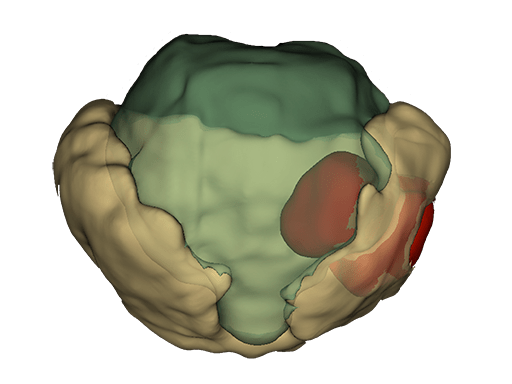
We released Prostate158, a large, publicly available dataset of 158 expert-annotated biparametric 3T prostate MRIs. This dataset, which includes T2-weighted sequences and diffusion-weighted sequences with apparent diffusion coefficient maps, is now available on Zenodo (https://zenodo.org/records/6481141). Trainings code for AI segmentation models is available on GitHub (https://github.com/kbressem/prostate158). We believe that Prostate158 will serve as a valuable resource for researchers developing and evaluating prostate segmentation algorithms.
In our accompanying study, published in Computers in Biology and Medicine (https://doi.org/10.1016/j.compbiomed.2022.105817), we introduce the Prostate158 dataset and also present baseline U-ResNet models trained for segmentation of prostate anatomy (central gland and peripheral zone) and suspicious lesions for prostate cancer (PCa) with a PI-RADS score of ≥4. Our models achieved promising results, with Dice similarity coefficients (DSCs) of 0.88 for the central gland, 0.75 for the peripheral zone, and 0.45 for PCa when compared to expert annotations.
To demonstrate the generalizability of our baseline model, we evaluated its performance on two external datasets: the Medical Segmentation Decathlon and PROSTATEx. We were pleased to see that the model showed good generalizability for anatomical segmentations, achieving DSCs of 0.82-0.86 for the central gland and 0.64-0.71 for the peripheral zone.
One of the main motivations behind creating Prostate158 was to address the need for standardized, expert-annotated datasets in prostate MRI research. We believe that our dataset complements existing resources such as PROSTATEx and will help foster reproducibility and comparability in the development of prostate segmentation algorithms.
By providing both the annotated MRI data and the code for our baseline models, we aim to encourage researchers to build upon our work and create more accurate and robust algorithms for prostate segmentation and cancer detection.
 AIAH Lab